
How to Prepare a Camper for Pickup: A Removal-Day Checklist
Most of what goes right or wrong on camper removal day is decided before the truck shows up. Whether it’s an old travel trailer, pop-up, fifth wheel or motorhome, two questions come up on almost every job: can the truck get to the camper, and do the tires hold air? This checklist covers both, then the smaller jobs (propane, batteries, tanks, paperwork and photos) that keep the day safe and the quote accurate.
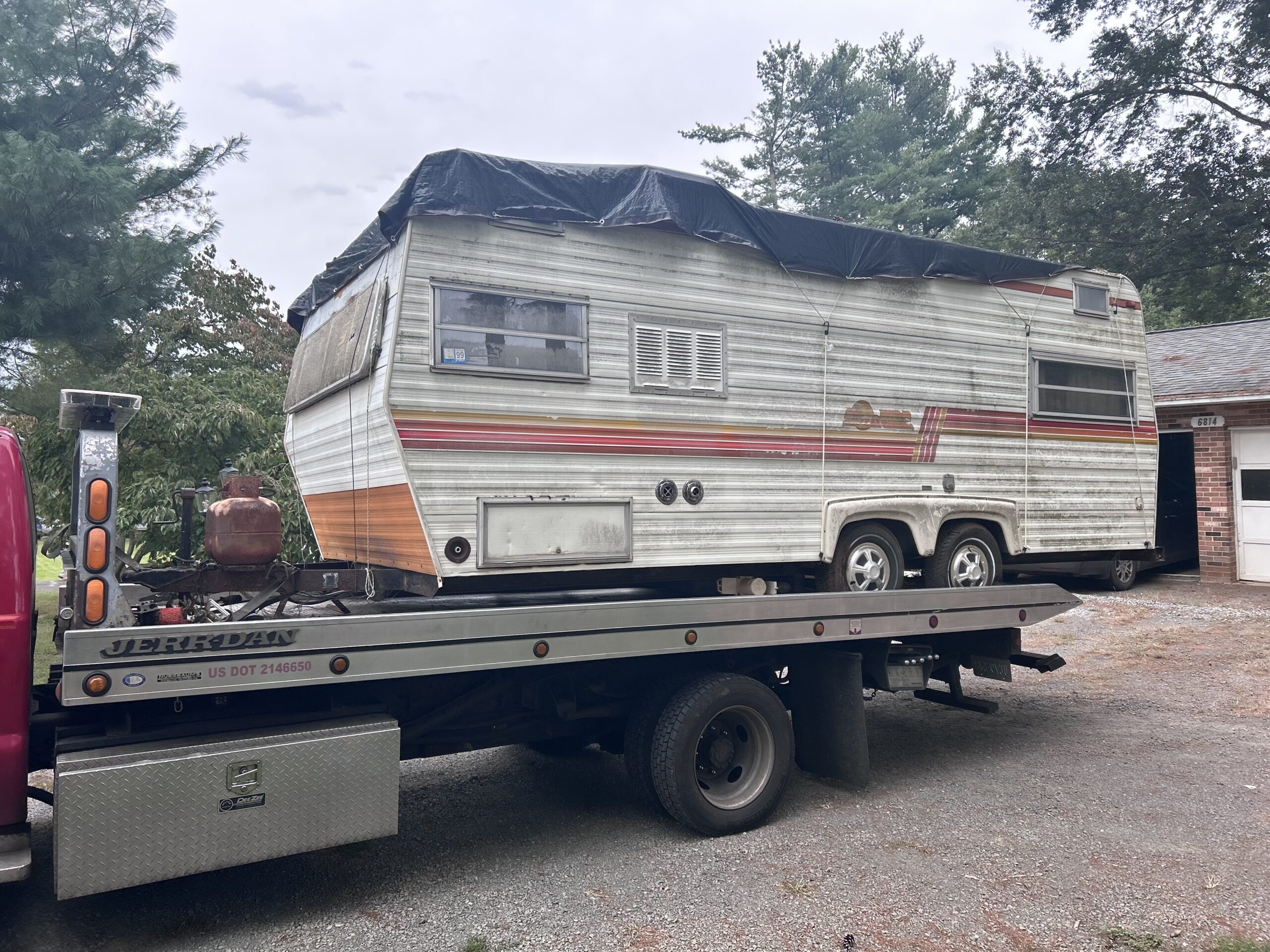
Part 1: Can the truck get to your camper?
A removal truck has to back up close to your camper, line up with it, and pull out again carrying a heavy load. Walk the route from the road to the camper and check the following.
Driveway and gate width
Measure the narrowest point between the road and the camper, such as gate posts, a gap between a house and a fence, or two trees, and include it with your quote request. If a fence panel or gate can come off for the day, say so.
Overhead clearance
Look up along the whole path. Low limbs, sagging power or cable lines and carport roofs can stop a truck, and a camper sitting on a truck is taller than one sitting on the ground. Trim limbs ahead of time, but never near power lines; call your utility for those.
Soft ground, mud and slopes
If it has rained recently, or the route crosses a septic field, a ditch, sand or a steep slope, tell us. Sometimes the best plan is to wait for a few dry days.
Turning room and distance from the road
Note roughly how far the camper sits from the nearest paved road and whether a truck can turn around or must back in the whole way. A unit tucked behind a house or deep in the woods can still be removed, but distance and tight turns change the time and equipment needed.
Clear the path
- Move cars, boats, trailers, mowers and other vehicles out of the way, and keep them out of the way on pickup day.
- Pick up hoses, extension cords, lawn furniture, bricks, blocks, lumber and anything stored under or beside the camper.
- Cut tall grass and brush around the unit so the crew can see the tires, the frame and the ground.
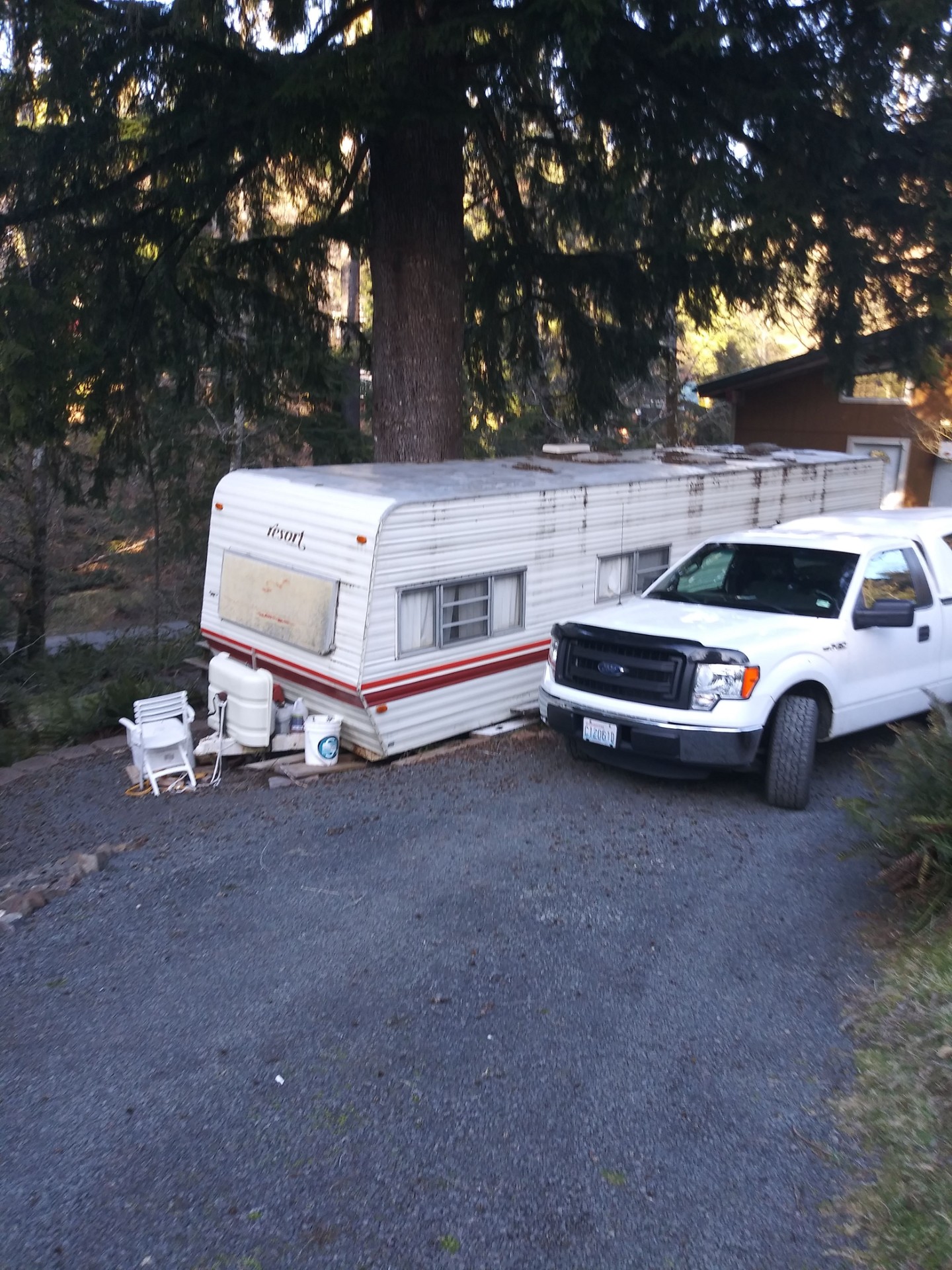
Send photos of the path, not just the camper
Take one photo from the street looking toward the camper, one from the camper looking back toward the road, and one of any gate, tight spot or low branch. Those three pictures answer most access questions.
Part 2: Do the tires hold air?
A camper that rolls on its own wheels is far easier to pull or winch into position. One with flat, rotted or seized wheels can still be removed, but the crew needs to know ahead of time.
Check and inflate the day before
The National Highway Traffic Safety Administration (NHTSA) says the correct pressure is the one listed by the vehicle manufacturer, not the number printed on the tire itself, and that pressure should be checked when tires are “cold.” Inflate the tires the day before pickup and check them again the next morning. A tire that’s soft by morning has a slow leak, and the crew should know.
Look for dry rot and age
NHTSA notes that tire aging is a particular risk for recreational vehicles and other vehicles that aren’t driven regularly, and that sun exposure and hot climates speed it up. It recommends taking tires out of service if they show cuts, cracks or bulges, and says some manufacturers recommend replacing tires that are six to 10 years old regardless of tread. The last four digits of the DOT Tire Identification Number on the sidewall show the week and year the tire was made. Photograph any cracked or flattened tire.
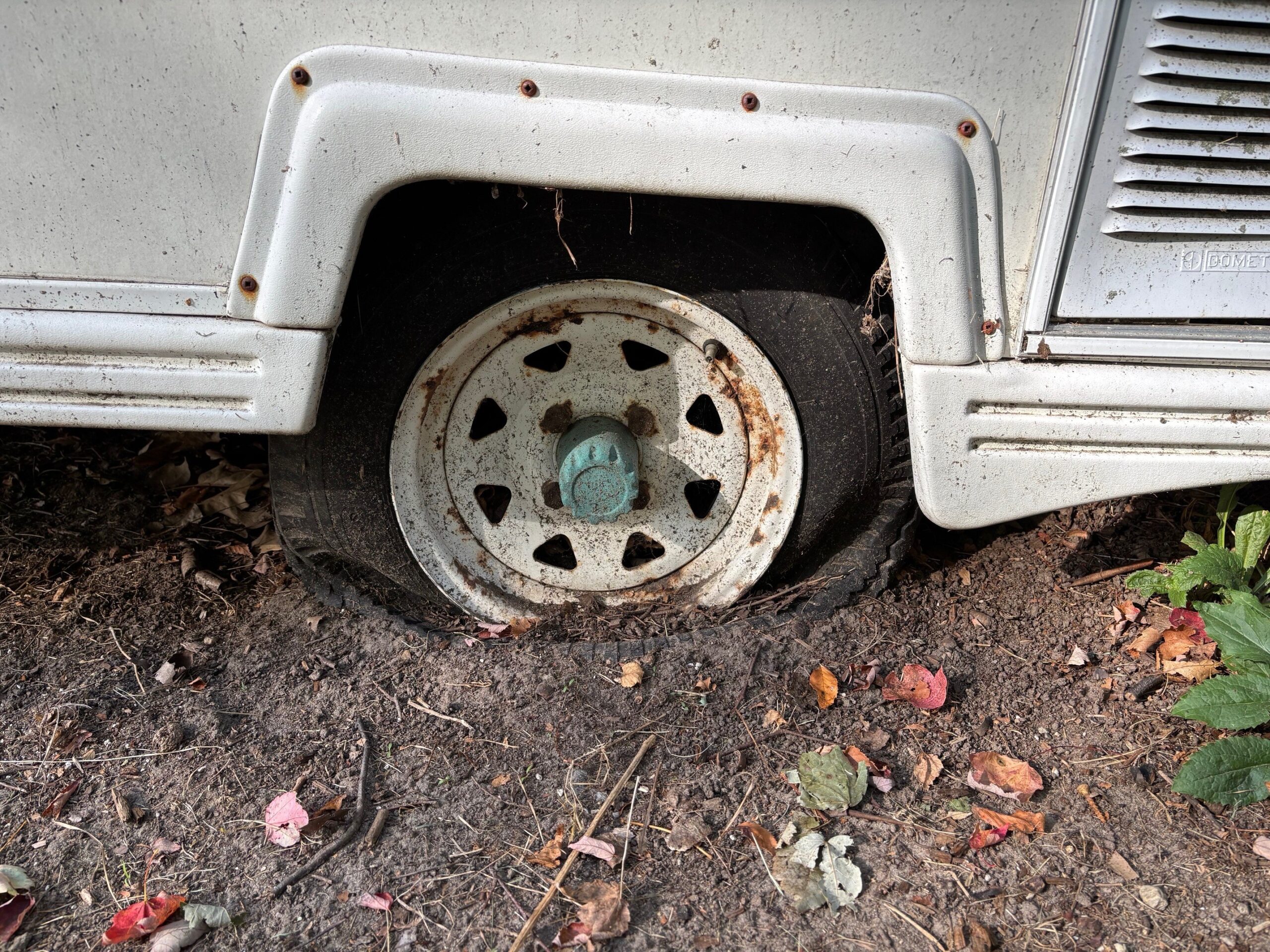
If a tire won’t hold air
You don’t need to buy new tires for a camper you’re getting rid of. Just tell us which tires won’t hold air and send a photo of each. For more on how flat-tire campers get hauled away, see our earlier post, Flat Tires? Forgotten Campers? We’ll Haul It All.
Wheels, brakes, jacks and the hitch
- Seized wheels or brakes: If the camper hasn’t moved in years, the wheels may not turn even with good tires. Tell us if it won’t budge.
- Jacks and stabilizers: Raise every stabilizer jack all the way. If any are rusted in place or bent, say so.
- Tongue, coupler and kingpin: Make sure the tongue jack cranks and the coupler isn’t rusted shut. On a fifth wheel, check the kingpin and pin box. Note any rusted-through frame.
- Motorhomes: Tell us whether it starts, drives and stops.
Part 3: Inside the camper
Remove personal belongings
Check every cabinet, drawer, under-bed compartment and outside storage bay. Once the camper is loaded, assume you won’t get anything back. If it’s full of trash or junk, mention that in your quote request.
Propane cylinders
Turn every propane valve off. The Propane Education & Research Council (PERC) advises keeping cylinder valves closed when not in use, keeping cylinders upright, and never transporting a leaking one. If you’re keeping portable cylinders, disconnect them before pickup. If you smell gas or hear hissing, PERC says to close the valve only if there are no flames or visible gas cloud, leave the area and call 911 or the fire department.
Batteries
Tell us how many batteries are on the unit. If you want to keep one, remove it before pickup day; otherwise leave it in place rather than half-disconnected.
Holding tanks and fresh water
Empty the black and gray tanks at a dump station, or have a licensed pump-out service come to the camper. The City of Oakland, for example, notes that local and California state rules prohibit discharging pollutants to streets, gutters or storm drains, and that dump stations and mobile pump-outs are the legal options. A U.S. EPA factsheet adds that some tank deodorizers contain chemicals such as formaldehyde that can harm septic systems and ground water. Never open a tank valve onto the ground. Drain the fresh water tank to lighten the camper, and if the waste tanks can’t be emptied, say so in your quote request.
Part 4: Paperwork, keys and people
Title and paperwork
Find the title early; if it’s lost, a duplicate can take time. Rules differ by state, so check with your motor vehicle agency. In Florida, for example, the Department of Highway Safety and Motor Vehicles says sellers must transfer the title, apply for a duplicate if a paper title is lost, and file a Notice of Sale (form HSMV 82050) to avoid liability after the sale. Remove your license plate and keep copies of what you sign.
Keys
Gather the door, storage bay and (for a motorhome) ignition keys. If any are missing, tell us ahead of time.
Someone present, or clear instructions
If you’ll be there, walk the crew around and point out soft ground and anything that shouldn’t be moved. If not, send written instructions: gate code, where to park, which camper it is, and a phone number for someone who can answer questions.
Pets and kids clear
Loading means a truck backing up and a heavy unit moving. Keep children and pets inside or well away until the truck has left.
What photos to send for a quote
- The whole camper from each side and both ends.
- Each tire, close enough to see cracks or flats.
- The hitch or kingpin and the tongue jack.
- The view from the road to the camper, plus any gate, low limb or tight spot.
- The inside, so we can see whether it’s empty.
- The title or the VIN plate.
Run the details through our camper removal cost calculator for a starting estimate, and check the Remove My Camper FAQ for common questions about payment and recycling. Free removal is only considered for campers in really good condition, case by case after we see photos; most removals are paid.
When your photos are ready, send them through our contact page, email [email protected], or call (855) 713-6280. We remove campers nationwide.
“If you don’t shop our prices, we both lose — John Arwood”
Printable pickup-day checklist
- ☐ Path measured; gates open or removable; vehicles moved
- ☐ Overhead limbs and wires checked; brush and grass cut
- ☐ Ground firm, or soft spots reported
- ☐ Tires inflated the day before and checked the morning of pickup
- ☐ Flat, cracked or seized wheels photographed and reported
- ☐ Stabilizer jacks up; tongue jack works; hitch or kingpin checked
- ☐ Personal belongings removed
- ☐ Propane valves closed; cylinders you’re keeping removed
- ☐ Batteries you’re keeping removed
- ☐ Black and gray tanks emptied legally; fresh water drained
- ☐ Title, keys and license plate handled
- ☐ Someone present, or access instructions sent
- ☐ Kids and pets kept clear
Frequently asked questions
Do I need to be home when the camper is picked up?
Not always. If the camper is easy to reach, the paperwork and keys are handled ahead of time, and you send clear access instructions, pickup can often happen without you. If the path is tight or paperwork still needs a signature, plan to have someone there.
What if my camper’s tires won’t hold air?
Tell us before removal day and send a photo of each tire. A camper that can’t roll may need different equipment or extra time, which affects the quote, but it can still be removed.
Should I leave the propane tanks on the camper?
Close every propane valve and tell us how many cylinders are on the unit. If you want to keep portable cylinders, remove them before pickup and store them upright, outdoors, away from heat. Never move a cylinder that smells of gas or is hissing.
Can I dump the holding tanks on the ground before pickup?
No. Black and gray water should only go into an RV dump station, an approved sewer connection, or a licensed pump-out service. Local and state rules prohibit draining wastewater into streets, gutters or storm drains, and fines can apply.
Is camper removal free?
Usually not. Free removal is only considered for campers in really good condition, case by case, after we see photos. Most removals are paid jobs, and the cost depends on the unit, its condition, its location and how easy it is to reach and load.
Sources
- National Highway Traffic Safety Administration, “Tires” (TireWise: tire pressure, aging and inspection): https://www.nhtsa.gov/equipment/tires
- Propane Education & Research Council, “Safety Guide for Portable Propane Cylinders”: https://propane.com/safety/safety-guide-for-portable-propane-cylinders/
- U.S. EPA, “Safe Wastewater Disposal for RV, Boat, and Mobile Home Owners and Operators”: https://www.epa.gov/septic/safe-wastewater-disposal-rv-boat-and-mobile-home-owners-and-operators
- City of Oakland, CA, “Recreational Vehicle (RV) Wastewater Disposal Tips”: https://www.oaklandca.gov/Community/Community-Development/Sustainability-Environment/Creeks-Watershed-and-Stormwater/Recreational-Vehicle-RV-Wastewater-Disposal-Tips
- Florida Department of Highway Safety and Motor Vehicles, “Selling a Vehicle”: https://www.flhsmv.gov/safety-center/consumer-education/selling-vehicle-florida/